
How to Choose the Right Tool Holder for Different CNC Machining Tasks
Posted: May 7, 2026 Filed under: Uncategorized Leave a commentTool holder selection directly affects machining stability, dimensional accuracy, surface finish, and tool life. When problems such as chatter, oversized holes, unstable threads, taper errors, or inconsistent finishes continue even after speeds and feeds are adjusted, the holder is often part of the root cause. Different CNC tasks place different demands on the holder-tool assembly, especially in clamping force, rigidity, runout control, coolant delivery, and damping behavior. A holder that works reasonably well in one operation may still create avoidable error in another.
Why Tool Holder Selection Should Start With the Cutting Task
Many machining issues are first treated as parameter problems. In practice, however, the holder changes how the tool behaves under load. It influences how securely the tool is retained, how much the assembly deflects, how evenly the cutting edges engage the material, and how heat and chips are managed near the cutting zone. For that reason, holder selection should begin with the dominant technical requirement of the operation rather than with the assumption that one familiar holder style can cover most jobs.
One practical way to select a tool holder is to identify the dominant failure risk in each machining process first.
- Milling: the main risk is often vibration or tool pull-out under side load.
- Drilling: the main risk is usually runout-driven hole inaccuracy, poor roundness, or chip evacuation problems.
- Reaming: the main risk is loss of hole tolerance and surface finish caused by even slight concentricity error.
- Tapping: the process is highly sensitive to torque transfer and axial behavior, which can lead to thread damage or tap breakage.
- Boring: the main concern is often overhang-induced vibration, deflection, and diameter instability.
- Turning / multitasking: the key risks are interference, insufficient rigidity, and inconsistent repeatability across setups.
The Performance Priorities Change Across CNC Machining Tasks
Before looking at each operation in detail, it helps to compare what the holder is actually being asked to do in different conditions.
| Machining task | Primary holder priorities | What commonly goes wrong with a poor match |
| Milling | Rigidity, gripping force, vibration resistance | Chatter, tool pull-out, uneven finish |
| Drilling | Runout control, axial stability, coolant access | Hole oversize, poor roundness, chip packing |
| Reaming | Very low runout, concentricity, smooth rotation | Tolerance drift, rough bore finish, inconsistent sizing |
| Tapping | Torque transmission, axial accuracy, stable engagement | Thread damage, tap breakage, poor repeatability |
| Boring | Rigidity, damping, balance in overhang conditions | Chatter marks, taper, unstable bore diameter |
| Turning / multitasking | Accessibility, repeatability, interference control | Clearance issues, unstable cutting, setup inconsistency |
Holder selection cannot be reduced to convenience alone. A setup optimized for gripping force is not automatically optimized for concentricity, and a general-purpose holder may not deliver the damping or runout control required by more demanding finishing operations.
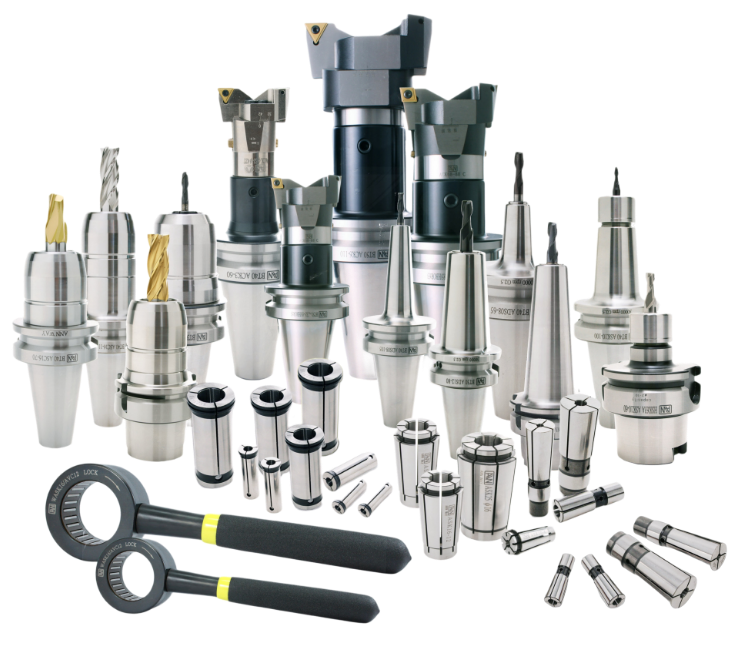
Milling Rewards Rigidity, but Not at the Expense of Balance
In milling, the holder must resist radial cutting forces, interrupted engagement, and changing tool loads. This is why rigidity is usually the first selection criterion. If the holder-body-tool assembly deflects too easily, cutting forces become less predictable, vibration increases, and edge loading becomes uneven. The visible symptoms may be chatter, poor wall finish, shortened tool life, or inconsistent dimensional results across multiple parts.
However, rigidity alone does not solve every milling problem. At higher spindle speeds, balance quality and runout become more important because dynamic instability rises with RPM. A holder that performs well in heavier roughing may not be ideal for high-speed finishing or tighter surface requirements. In other words, milling holder selection is not simply about choosing the strongest clamp. It is about matching stiffness, grip, and rotational accuracy to the actual cutting strategy.
Drilling and Reaming Expose Small Errors Very Quickly
Drilling often appears forgiving, but the process amplifies small alignment errors. Excessive runout means one cutting edge engages earlier and more aggressively than the other, which leads to uneven wear, inaccurate hole size, and poor roundness. As hole depth increases, coolant delivery and chip evacuation become equally important. If chips are not removed efficiently, heat builds up, friction rises, and hole quality deteriorates even if the drill itself is in good condition.
Reaming is even less tolerant. Because it is typically a finishing operation, the holder must support near-uniform rotation and excellent concentricity. Even minor deviation at the holder interface can show up as inconsistent bore size or surface damage. A holder that is acceptable for general drilling may therefore still be unsuitable for reaming.
Tapping and Boring Demand Process-Specific Control
Tapping introduces a different type of risk because the holder must manage torque and axial motion in a controlled way. If engagement is unstable, the process can fail quickly through broken taps, damaged thread form, or poor consistency from hole to hole. What matters here is not only holding strength, but also how well the holder supports synchronization demands and how much misalignment it allows or absorbs under real cutting conditions.
Boring creates the opposite kind of challenge. The longer the overhang, the more sensitive the system becomes to vibration and deflection. A boring setup may appear acceptable when static, yet behave poorly once cutting forces begin to oscillate. In these cases, the holder must contribute to stiffness and damping, not merely tool retention. Diameter variation, taper, and chatter marks are often signs that the system’s dynamic behavior was underestimated.
Why a Single Holder Strategy Usually Creates Hidden Costs
Standardizing around too few holder types may simplify storage and setup, but it often pushes complexity back into the machining process. The result can be reduced cutting parameters, more frequent tool changes, extra inspection, or repeated troubleshooting at the machine. What looks efficient at the tooling level may become costly at the process level.
A stronger selection strategy is to match holder choice to the dominant technical requirement of the task:
- Prioritize rigidity and grip for heavy or unstable milling conditions
- Prioritize runout control and coolant support for drilling and reaming
- Prioritize torque transfer and axial behavior for tapping
- Prioritize damping and stiffness in overhang conditions for boring
- Prioritize access and repeatability in turning and multitasking setups
This kind of framework is more practical than searching for a universal holder because machining priorities do not remain constant from one operation to another.
A More Practical Way to Evaluate Tool Holding Systems
The most effective tool holding systems are not defined by how many applications they claim to cover, but by how well they address operation-specific problems. This is also why manufacturers with wider engineering coverage can provide more useful support: they are better positioned to align holder design with actual machining conditions rather than forcing every task into a narrow product logic.
Ann Way reflects this broader application-based approach through several practical strengths:
- Coverage across multiple machining tasks, including milling, drilling, reaming, tapping, boring, and turning
- A product mix that supports both general and precision-oriented applications, especially where rigidity and runout control are critical
- The ability to support more specialized setups, not only common tool holding needs but also boring, tapping, and multitasking operations
Choosing the right holder should be treated as part of process engineering because the benefits are measurable: more stable machining, better part quality, longer tool life, and fewer unexplained failures.
 B2B Tool Online